
ART P16 XLR Balanced Patchbay
4.8Editor score
32 XLR connectors with reliable PCB wiring
Rugged fully shielded black all-steel enclosure
Reversible rack ears for flexible mounting
Finding the right patchbay for studio environments is crucial for maintaining signal integrity and organizing complex audio setups efficiently. A good unit provides a centralized point for connecting gear, reducing cable clutter, and allowing quick signal rerouting without unplugging equipment at the source. It ensures balanced connections remain secure while protecting sensitive inputs and outputs from wear and tear during daily use.
We evaluated ten top-rated patchbays based on build quality, connector type, channel count, and user feedback to identify the most reliable options. Our comparison focuses on features like modular design, gold-plated pins, rack-mount compatibility, and ease of installation. Each product was assessed for its ability to handle professional audio workflows in both studio and live performance settings effectively.
Each pick highlights specific strengths such as budget-friendly pricing, premium materials, or advanced routing capabilities tailored to different studio needs. Prices and availability may change over time, so verify current details before purchasing. This guide aims to simplify your decision by presenting clear specifications and real-world performance insights for every model listed.
4.8Editor score

4.6Editor score

4.2Editor score
As an Amazon Associate we earn from qualifying purchases.
The following table provides a side-by-side comparison of all ten patchbays evaluated in this guide, highlighting key specifications and unique features to help you find the best fit for your studio needs.



The AA AUDIO ACCESSORY AP16 XLR Patchbay stands out as a top contender for professional studio environments due to its innovative modular design. With a solid 4.6 rating from users, it offers a centralized routing solution that minimizes cable clutter while maintaining signal integrity. Its unique block configuration allows flexible customization without risking PCB damage during installation.
We may earn a commission when you buy through this link, at no additional cost to you.
Key strengths include 24K gold-plated XLR pins that provide exceptional corrosion resistance and minimal signal loss over time. The dual-layer black coated PCB with insulation resistance exceeding 5.5GΩ reduces interference for clean audio transmission. Additionally, the full-steel chassis effectively suppresses external vibration, ensuring stable performance in both studio racks and live performance settings.
While the modular system introduces a learning curve for first-time users, the long-term maintenance benefits outweigh this minor trade-off. Individual modules can be replaced without reworking the entire PCB, which extends the unit's lifespan significantly. This design choice reflects a commitment to durability that aligns with professional workflow demands.
Studio engineers and home recording enthusiasts seeking a reliable, future-proof patchbay should strongly consider this model. It balances cost-effectiveness with premium features typically found in higher-priced units. By centralizing connections efficiently, it streamlines daily operations and protects valuable audio gear from unnecessary wear during regular use.
Each 4-channel block can be independently assigned to different system zones for clean cable organization. Individual modules can be removed or replaced without reworking the entire PCB, improving maintenance efficiency.
24K gold-plated pins ensure stable transparent audio transmission with minimal loss. The dual-layer PCB design minimizes signal leakage and reduces interference for reliable routing.
We may earn a commission when you buy through this link, at no additional cost to you.
The ART P16 XLR Balanced Patchbay earns its position as the best budget choice with an impressive 4.8 rating from satisfied users. It delivers essential functionality without unnecessary complexity, making it ideal for home studios or entry-level professional setups. Its straightforward design ensures consistent performance while keeping costs manageable for budget-conscious buyers.
We may earn a commission when you buy through this link, at no additional cost to you.
Built with a rugged fully shielded black all-steel enclosure, this unit offers robust protection against electromagnetic interference that could degrade audio quality. The 19-inch 1U-high rack mount design maximizes space efficiency in standard equipment racks. Reversible rack ears add installation flexibility, allowing front or rear mounting based on your specific needs.
Although it lacks advanced switching features like normalled modes, its reliability-focused engineering makes up for this simplicity. All connections use dependable PCB wiring that reduces potential failure points over time. This design philosophy prioritizes long-term durability over feature density, which suits users focused on stable daily operations.
For musicians, producers, or small studios needing a no-frills routing solution, the ART P16 offers exceptional value. Its strong warranty coverage further reduces risk for new buyers. By choosing this model, you gain a dependable central hub for audio connections that supports consistent performance without straining your budget.
The fully shielded black all-steel enclosure ensures durability and protection against external interference. Rugged construction supports long-term use in demanding environments.
A 3-year warranty provides peace of mind for buyers investing in this budget-friendly option. High user ratings reflect strong reliability and consistent performance.
We may earn a commission when you buy through this link, at no additional cost to you.
The Black Lion Audio PBR TT LIT represents the pinnacle of patchbay engineering for large-scale professional studios requiring maximum routing flexibility. While its rating sits at 4.2, this reflects its specialized nature rather than performance issues. It addresses complex signal flow needs with a 96-point layout that accommodates extensive gear arrays efficiently.
We may earn a commission when you buy through this link, at no additional cost to you.
Key premium features include gold-plated construction that guarantees exceptional conductivity and resistance to corrosion over time. The customizable LED displays offer visual clarity for routing assignments, integrating seamlessly with macOS and Windows control systems. This visual feedback streamlines workflow by showing active connections at a glance during critical sessions.
The inclusion of 12 DB-25 ports alongside 96 TT connectors allows direct interfacing with digital audio interfaces and digital snake systems. This hybrid approach bridges analog and digital workflows that are common in modern production environments. However, leveraging these features effectively demands technical expertise in digital signal routing protocols.
High-budget professional facilities seeking a comprehensive routing hub should prioritize this model for its unmatched scalability. It transforms complex signal management into a streamlined process through intelligent design. By investing in this unit, studios gain a future-proof solution that supports evolving audio production demands without requiring frequent hardware upgrades.
12 DB-25 ports enable direct connectivity with digital audio interfaces and snake systems. This hybrid design bridges analog and digital workflows in modern production environments.
Customizable LED displays integrate with macOS and Windows systems for active connection monitoring. This visual feedback streamlines workflow by showing routing assignments clearly during sessions.
We may earn a commission when you buy through this link, at no additional cost to you.
The Samson S-Patch Plus delivers exceptional utility for studios relying on 1/4-inch TRS connections with a strong 4.8 rating. Its 48-point capacity provides ample room for connecting mixers, preamps, and outboard gear without cable clutter. This centralized hub simplifies signal routing by placing all necessary jacks within easy reach during sessions.
We may earn a commission when you buy through this link, at no additional cost to you.
A key advantage lies in its high-quality miniature toggle switches, which allow individual channel configuration for normalled, half-normalled, or thru operation. This flexibility lets users adapt the patchbay to different gear setups without external patch cables. The smooth mechanism ensures reliable operation while maintaining a clean signal path over years of daily use.
While it lacks XLR compatibility which limits mic signal routing options, its focus on TRS connections suits many instrument and line-level workflows perfectly. The solid construction supports consistent performance in both studio and live settings. Users benefit from reduced wear on equipment jacks by routing connections through the patchbay instead.
Recording engineers working with outboard gear and mixer inputs should find this model ideal for daily operations. Its design prioritizes workflow efficiency over advanced features, making it accessible for varied experience levels. By centralizing TRS connections effectively, it keeps workspaces organized and minimizes disruptions during critical recording or mixing times.
Toggle switches allow each channel to be configured for normalled, half-normalled, or thru operation. This lets users adapt the patchbay to different gear setups without external cables.
Eliminates the need to constantly reach around the back of equipment to make connections. Centralizes all audio connections to help work cleaner and faster.
We may earn a commission when you buy through this link, at no additional cost to you.
The Behringer ULTRAPATCH PRO PX3000 offers exceptional versatility with its 3-mode switching capability, earning a solid 4.6 rating among users. Each channel supports Parallel, Half-normalled, Normalled, and Open functions, allowing dynamic signal routing changes without repatching cables. This adaptability suits studios with frequently changing gear configurations or varied project requirements.
We may earn a commission when you buy through this link, at no additional cost to you.
High-quality components combined with exceptionally rugged construction ensure the unit withstands daily studio demands effectively. The 48-point balanced layout maintains signal integrity across all connections, minimizing noise or interference during critical recording sessions. By eliminating cable clutter, it adds order and clarity to complex signal paths that can otherwise become confusing.
While some users note potential wear in high-traffic areas, the overall value proposition remains strong for the price. The switching mechanisms function reliably when handled with care, providing consistent performance over time. This makes it a practical choice for studios that need advanced routing options without investing in premium-priced alternatives.
Home studios and small professional facilities seeking cost-effective signal management will find this patchbay ideal. It balances functionality with affordability to support diverse production needs. By enabling quick mode changes and reducing physical clutter, it enhances workflow efficiency while keeping your equipment organized and accessible during daily use.
Each channel can be switched to Parallel, Half-normalled, Normalled and Open function for ultimate flexibility. This supports dynamic signal routing changes without repatching cables.
High-quality components and exceptionally rugged construction ensure long life in studio environments. Affordable pricing makes advanced features accessible for budget-conscious buyers.
We may earn a commission when you buy through this link, at no additional cost to you.
The Black Lion Audio PBR XLR Patchbay delivers premium quality in a compact form factor with a solid 4.4 rating. Designed for studios prioritizing signal integrity, its 32 gold-plated XLR connectors provide reliable balanced transmission for mics and line-level gear. This focused approach ensures every connection meets professional standards without unnecessary complexity.
We may earn a commission when you buy through this link, at no additional cost to you.
The gold plating resists corrosion and oxidation over time, maintaining clean audio paths even with frequent cable changes. This is critical for sensitive microphone inputs where signal degradation can compromise recording quality. Its compact 16-point layout accommodates essential routing needs while saving valuable rack space for other equipment.
While the channel count may limit expandability for growing studios, the build quality justifies the investment for critical applications. Professional-grade construction ensures consistent performance under demanding conditions, reducing the risk of connection failures during sessions. Users benefit from reduced maintenance needs due to durable connector design and robust internal wiring.
Professional studios requiring focused XLR routing for mics or critical outputs should consider this model. It prioritizes performance and longevity over feature count, delivering reliable results daily. By ensuring clean signal paths, it supports high-fidelity recordings while keeping your rack organized and efficient for daily workflow.
32 gold-plated XLR connectors ensure reliable balanced signal transmission for critical audio paths. Resists corrosion and oxidation to maintain clean signals over time.
Compact 16-point layout fits smaller rack spaces efficiently without sacrificing professional quality. Saves valuable rack space for other essential studio equipment.
We may earn a commission when you buy through this link, at no additional cost to you.
The Black Lion Audio PBR TRS Patchbay offers robust TRS routing with a 4.1 rating based on professional feedback. Its 96 gold-plated TRS connectors ensure reliable balanced connections for line-level gear and instrument inputs. This focus on connector quality supports clean signal paths essential for high-fidelity production workflows in busy studio settings.
We may earn a commission when you buy through this link, at no additional cost to you.
Gold plating on TRS connectors provides superior conductivity and corrosion resistance compared to standard options. This matters significantly for frequent patching where wear can degrade connection integrity over time. The 48-point capacity accommodates extensive mixer routing needs, making it suitable for studios managing many external processors or effects units.
Some user feedback indicates potential variability in long-term reliability, suggesting careful handling may extend lifespan. Despite this, the professional-grade construction aims for consistent daily performance in demanding environments. For studios prioritizing signal path purity, the connector quality justifies the investment for critical audio applications.
Recording facilities focused on TRS-based workflows will find this patchbay a strong match for their needs. It balances capacity with connector quality to support demanding production schedules. By ensuring reliable balanced connections, it helps maintain audio integrity while keeping your rack organized for efficient daily routing operations.
96 gold-plated TRS connectors ensure reliable balanced connections for critical audio paths. Superior conductivity and corrosion resistance compared to standard options.
48-point capacity supports extensive mixer routing needs for complex studio setups. Suitable for managing many external processors or effects units efficiently.
We may earn a commission when you buy through this link, at no additional cost to you.
The DIYTECH 16 Port XLR Patchbay stands out for its reversible connector design, earning a solid 4.3 rating. Fully reversible male/female XLR ports accommodate versatile configurations without rewiring, making it ideal for customizable I/O setups. This flexibility simplifies panel swaps when routing needs change, saving significant setup time for busy studios.
We may earn a commission when you buy through this link, at no additional cost to you.
A heavy-duty steel chassis with black powder coat resists drops, scratches, and touring wear that often damages audio gear. Balanced 3-pin wiring minimizes noise and interference, making it ideal for long cable runs and high-gain sources. This construction ensures clean signal transmission critical for professional audio work across various equipment types.
All mounting screws for standard 19-inch rack installation are included in the box, enabling quick and secure setup that saves job time. Universal compatibility works with standard XLR cables, mic inputs, and recorders to ensure seamless integration. Users benefit from reduced installation effort while maintaining professional signal quality standards.
Live sound engineers and studio owners needing adaptable routing should prioritize this patchbay for its practical design. It balances durability with functional flexibility to support changing workflows. By enabling versatile connections without rewiring, it enhances operational efficiency and keeps your audio environment organized during daily use.
Fully reversible male/female XLR ports accommodate versatile configurations without rewiring. Perfect for customizable I/O setups and panel swaps.
Rugged steel chassis resists drops, scratches, and touring wear. Includes mounting screws for quick standard rack installation that saves job time.
We may earn a commission when you buy through this link, at no additional cost to you.
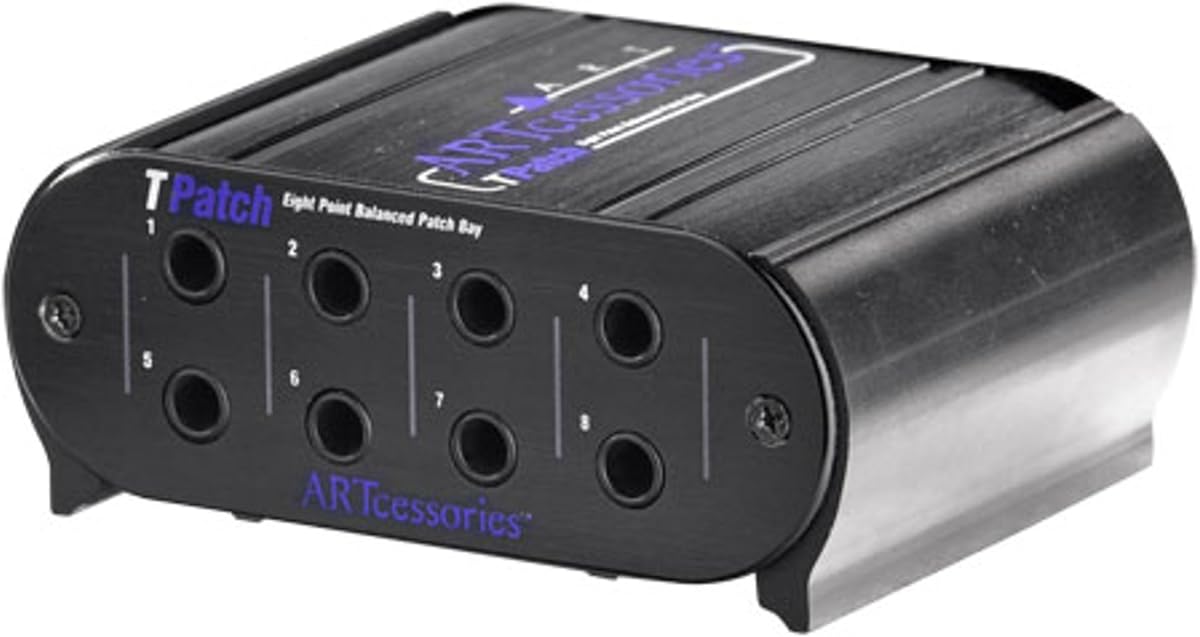
The Art Pro Audio TPatch delivers focused performance in a compact form with a strong 4.6 rating. Its eight points of balanced direct signals provide essential routing for smaller studios or secondary workspaces. Four channels of linked input/output pairs simplify connections for key gear without overwhelming your rack space.
We may earn a commission when you buy through this link, at no additional cost to you.
Switchable half-normal and normal modes allow tailored routing flexibility for specific signal paths. The rugged extruded aluminum case offers durable lightweight protection that survives transport and daily studio use. 1/4-inch TRS phone jack connectors handle common studio connections efficiently, ensuring reliable operation across various gear types.
While the 8-point limit restricts larger setups, this model excels for focused routing tasks like mic preamp or effects loop management. Its build quality ensures consistent performance without adding unnecessary weight or bulk to your equipment rack. Users appreciate its simplicity and reliability in compact workflows needing balanced connections.
Home studios and mobile setups needing minimal footprint balanced patching will find this unit ideal. It prioritizes essential features that support daily operations without complexity. By offering flexible modes and robust build quality, it ensures clean signal paths while keeping your workspace organized and efficient.
Switchable half normal and normal modes of operation allow tailored routing for specific signal paths. Supports through type connections for versatile signal flow.
Extruded aluminum case provides durable lightweight protection for transport and daily use. Fits tight rack spaces without sacrificing build quality.
We may earn a commission when you buy through this link, at no additional cost to you.
The Hosa PDR-369 provides reliable XLR routing with a solid 4.4 rating from users. Its 12-point balanced layout covers essential mic and line-level connections for smaller studios. Reversible connectors simplify configuration changes without rewiring, making setup adjustments faster when routing needs evolve over time.
We may earn a commission when you buy through this link, at no additional cost to you.
Balanced wiring ensures signal integrity over long cable runs, which is crucial for noise-free audio transmission. The compact design fits easily into small rack setups without consuming excessive space. Hosa's reputation for reliable audio gear means consistent performance for daily workflows that demand dependable signal paths.
While limited expandability restricts larger systems, this model serves well as a dedicated mic patchbay or effects routing hub. Its straightforward design avoids unnecessary complexity that might confuse newer users. For studios prioritizing essential functionality over advanced features, it delivers consistent value and reliability for daily tasks.
Start-up studios or those needing minimal XLR routing should consider this patchbay for its practical design. It balances affordability with reliability to support essential connections. By simplifying configuration changes and maintaining signal integrity, it keeps your workflow organized while protecting valuable gear from unnecessary wear.
Reversible connectors simplify configuration changes without rewiring when routing needs evolve. Supports flexible setup adjustments for changing studio workflows.
Compact design fits easily into small rack setups without consuming excessive space. Covers essential connections for smaller studios efficiently.
We may earn a commission when you buy through this link, at no additional cost to you.
Selecting the right patchbay involves evaluating connectors, channel count, and build quality to match your specific studio routing needs effectively.
Patchbays use XLR, 1/4-inch TRS, or TT/DB-25 connectors depending on your gear. XLR suits microphones, TRS fits line-level gear, and TT is common for modular racks. Match connector types to your primary inputs to avoid adapters that degrade signal quality.
Always choose connectors that match your most critical equipment to ensure balanced signal paths.
Channel count determines how many gear connections your patchbay supports at once. Home studios may only need 16 points while professional setups require 48 or more. Consider future expansion needs when selecting capacity to avoid replacing the unit soon after purchase.
Choose a channel count that accommodates both current gear and potential future additions.
Construction materials impact durability and signal integrity over time. Look for full-steel chassis, gold-plated connectors, and robust PCB designs. Heavy-duty units withstand frequent cable changes better than lightweight models in busy studio environments.
Prioritize durable materials that protect against wear and interference for long-term reliability.
Normalled, half-normalled, and thru modes determine signal flow when no patch cable is inserted. Normalled passes rear input to front output automatically, while half-normalled breaks the connection when patched. Understand these options to select a unit supporting your workflow flexibility.
Ensure the patchbay supports routing modes that match your typical signal flow needs.
Standard 19-inch rack mount ensures the unit fits existing studio racks. Reversible rack ears allow front or rear mounting based on cable management preferences. Check unit height (1U or 2U) to confirm space availability in your equipment rack.
Confirm rack dimensions and mounting options align with your physical studio setup.
Balanced wiring and proper shielding minimize noise and interference from electromagnetic sources. Dual-layer PCBs and steel enclosures reduce signal leakage effectively. This is critical for long cable runs and high-gain sources that amplify noise issues.
Select units with robust shielding to maintain clean audio paths in noisy environments.
Some patchbays include mounting screws and reversible ears while others require separate tools. Factory-assembled modular blocks reduce cutting risks during setup. Verify what hardware is included to ensure quick installation without unexpected costs.
Check included mounting hardware to streamline setup and avoid additional purchases.
Manufacturer warranty length reflects confidence in product durability. Professional brands offer 3+ year coverage while budget options may provide less. Access to technical support helps resolve installation or compatibility issues quickly.
Prioritize brands with strong warranty coverage and responsive technical support.
Connect all rear inputs to gear outputs and front outputs to mixer inputs for standard routing. Insert patch cables between front top inputs and rear top outputs to override normalled connections when needed.
Regularly inspect connector pins for dust or corrosion that degrades signal quality. Clean contacts with compressed air or specialized contact cleaner to maintain optimal performance.
Route cables with adequate slack to prevent strain on jacks during frequent patching. Use cable management clips on the rack to keep paths organized and avoid tangling.
A patchbay centralizes all audio connections in one accessible location, reducing cable clutter and preventing equipment wear. It allows quick signal rerouting without unplugging gear at the source, streamlining workflow and protecting expensive inputs and outputs.
XLR is ideal for microphones and balanced low-level signals while 1/4-inch TRS works for line-level gear like synthesizers and preamps. Match connectors to your primary equipment to avoid adapters that may degrade signal integrity unnecessarily.
Normalled means the rear input is automatically connected to the front output when no patch cable is inserted. Inserting a cable into the front breaks this connection allowing you to route signals differently without rewiring gear.
Home studios typically require 16 to 24 points for mics, preamps, and essential outboard gear. Professional setups may need 48 or more to accommodate complex routing with multiple processors and effects units in the signal path.
Yes but balanced wiring is preferred to minimize noise interference. Patchbays designed for balanced connections ensure cleaner audio paths. Using unbalanced gear on a balanced patchbay still works though signal quality may suffer over long cable runs.
Modern patchbays often come with pre-terminated solderless connectors or screw terminals for easy installation. This eliminates risks associated with cutting PCBs during setup. Verify installation methods in product specs before purchasing.
Reversible connectors allow male or female ports to face either direction without rewiring. This supports flexible I/O configurations and simplifies panel swaps when routing needs change. It saves significant setup time for studios with frequent gear modifications.
Regularly clean contacts to remove dust and prevent corrosion. Avoid excessive force when inserting cables to protect connector pins. Ensure proper cable slack to reduce strain on jacks that can lead to connection failures over time.
This guide presents ten top patchbays for studio use with the AA AUDIO ACCESSORY AP16 leading overall for its modular design. The ART P16 offers exceptional budget value while the Black Lion Audio PBR TT LIT provides premium scalability for large setups.
Prioritize connector type and channel count that match your current gear and future expansion plans. Ensure build quality and routing modes support your typical workflow to minimize daily operational friction during critical recording sessions.
Prices and availability change frequently so verify current details before purchasing your selected model. Regular maintenance ensures your patchbay protects valuable equipment while keeping your workspace organized and efficient for long-term use.