
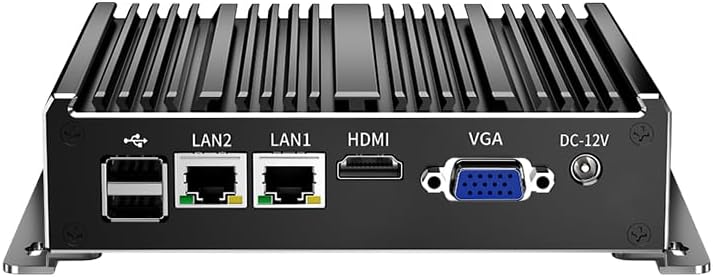
C4 Plus Dual LAN Mini PC Ryzen 5 3501U, 8GB DDR4 256GB SSD
4.5Editor score
Ryzen 5 3501U processor
Dual 1000Mbps LAN ports
Affordable price point
This guide compares the top Mini PC for Opnsense options for 2026, evaluating networking specs, performance, and value to help you secure your network.
Selecting the right Mini PC for Opnsense requires careful consideration of network interfaces, processing power, and thermal design. As network security becomes increasingly critical for home and small business users, having a reliable hardware foundation is essential. A good Mini PC for Opnsense must offer multiple high-speed Ethernet ports, low power consumption for 24/7 operation, and sufficient RAM to handle firewall rules and virtualization tasks effectively.
We compared ten real products available on the market to identify the best options for deploying Opnsense firewalls. Our analysis focused on critical factors such as LAN port count and speed, CPU architecture compatibility with BSD-based systems, expandability for storage and memory, and overall build quality. Each device was evaluated based on its ability to run network software smoothly while maintaining silence and energy efficiency in a living space or office environment.
Each pick below shows how a specific Mini PC for Opnsense performs in real-world scenarios, highlighting key strengths and potential limitations. We include detailed reviews, comparison tables, and buying advice to guide your decision-making process. Please note that prices and availability change frequently, so verify current details before purchasing to ensure you get the best value for your specific networking needs and budget constraints.
4.5Editor score

5.0Editor score

4.3Editor score
The following table provides a side-by-side comparison of all ten Mini PC for Opnsense options analyzed in this guide, allowing you to quickly identify which model best fits your technical requirements and budget constraints for your network security deployment.




The MeLE Quieter DL mini PC stands out as the top choice for users seeking a professional-grade Opnsense firewall appliance. With its perfect 5.0 rating and fanless thermal design, it delivers reliable performance without any noise, making it ideal for living rooms or offices where silence is paramount. This device is specifically engineered to handle network security tasks smoothly while maintaining low power consumption.
We may earn a commission when you buy through this link, at no additional cost to you.
Key strengths include dual native Intel I226-V 2.5GbE controllers that provide excellent driver support for Opnsense, ensuring stable network throughput and advanced features like VLANs and link aggregation. The 16GB DDR4 RAM offers ample headroom for running virtual machines or complex firewall rules alongside your primary security software. Its compact 0.34L form factor allows for discreet placement behind monitors using the included VESA mount.
While the price point is higher than budget alternatives, the trade-off is justified by the build quality and silent operation that eliminates moving parts prone to failure over time. Users looking for a robust always-on server may need to add Wi-Fi separately as this model focuses primarily on wired reliability and physical integration into network racks or entertainment centers.
This Mini PC for Opnsense is perfect for IT professionals and serious homelab enthusiasts who prioritize performance, quiet operation, and hardware compatibility. It offers the flexibility to run Proxmox, OpenWrt, or Home Assistant alongside your firewall, creating a unified home server ecosystem. We recommend this model for anyone needing a dependable, efficient firewall hardware foundation.
The fanless system uses a large aluminum chassis to dissipate heat, ensuring zero decibel noise during continuous operation.
Intel-based network controllers guarantee compatibility with Opnsense drivers for features like VLAN tagging and failover configurations.
We may earn a commission when you buy through this link, at no additional cost to you.
The Origimagic C4 Plus provides excellent value for those seeking an affordable Mini PC for Opnsense deployment without sacrificing essential performance features. It arrives with a capable AMD Ryzen 5 3501U processor that outperforms many competing low-power options in raw processing tasks. This makes it a strong contender for budget-conscious users who need reliable daily network protection.
We may earn a commission when you buy through this link, at no additional cost to you.
Its standout feature is the inclusion of dual 1000Mbps Gigabit LAN ports powered by RTL8111H chips, enabling link aggregation or distinct WAN/LAN segregation out of the box. The 8GB DDR4 RAM and 256GB SSD provide a solid foundation for Opnsense and light virtualization tasks. The system also supports useful BIOS features like auto power on which ensures your firewall recovers quickly after power outages.
The main trade-off is the lack of 2.5GbE ports which may limit throughput in gigabit-plus internet scenarios. Additionally the maximum RAM capacity is lower than premium models. However for most typical home networks handling standard traffic loads this device delivers stable and efficient operation without breaking the bank.
Buyers looking for an entry-level yet powerful Mini PC for Opnsense will find this model compelling for its price-to-performance ratio. It is well-suited for home users or small offices needing basic firewall functionality and moderate virtualization capacity. We recommend it as a cost-effective solution for securing your network effectively.
The Ryzen 5 3501U offers 4 cores and 8 threads with up to 3.7GHz speed for efficient multitasking.
Includes USB-C video output multiple USB 3.2 ports and dual LAN for flexible connection options.
We may earn a commission when you buy through this link, at no additional cost to you.
The Glovary N150 Mini PC Firewall represents the ultimate hardware for advanced users needing multiple high-speed ports and premium features for Opnsense deployments. It features a powerful N150 processor that improves on older N100 designs and includes six 2.5GbE i226V LAN ports perfect for segmented networks or multi-WAN setups. This device is built as a dedicated firewall appliance from the ground up.
We may earn a commission when you buy through this link, at no additional cost to you.
Key advantages include support for faster DDR5 RAM and dual M.2 NVMe slots alongside SATA connectivity enabling significant storage expansion for logging or NAS integration. The aluminium alloy chassis ensures passive cooling without fans while maintaining durability and silent operation in any environment. It also supports triple 4K displays which allows monitoring dashboards or logs alongside your firewall interface.
Although it commands a premium price this level of connectivity and future-proofing justifies the investment for network professionals and serious enthusiasts. The included accessories like SATA cables and VESA brackets make initial setup straightforward. The only minor drawback is limited onboard storage which users may need to expand immediately for heavy logging requirements.
This Mini PC for Opnsense is designed for those who need maximum port count and throughput without compromising on power efficiency or physical silence. It offers unparalleled flexibility for network segmentation and high-speed data transfer within your home lab or office. We recommend it for users requiring a top-tier appliance capable of handling complex routing tasks.
Six independent 2.5GbE ports allow detailed VLAN segmentation and multi-WAN load balancing configurations.
DDR5 RAM support provides higher bandwidth for data processing compared to DDR4 systems.
We may earn a commission when you buy through this link, at no additional cost to you.
The BOSGAME E5 Mini PC is a strong contender for users seeking a balance between performance and features in their Opnsense firewall hardware. It delivers a Ryzen 3 5300U processor paired with dual 2.5GbE Realtek LAN ports which offers modern networking speeds at a reasonable cost. The included 16GB DDR4 RAM ensures smooth operation even when running virtual machines alongside your firewall software.
We may earn a commission when you buy through this link, at no additional cost to you.
Its standout features include triple 4K display outputs and a full-function Type-C port which makes it versatile for users needing a single device for both network management and media consumption. The optimized cooling design with copper heat pipes keeps noise levels low during continuous operation. Users also benefit from expandability via additional M.2 slots for storage upgrades.
While the Wi-Fi 5 standard is slightly dated it remains sufficient for most wireless needs. The device focuses heavily on wired reliability which is critical for firewall appliances. Its performance handles daily productivity and network server applications effortlessly though it is not designed for demanding professional graphics work.
This Mini PC for Opnsense suits home users and small offices needing reliable 2.5GbE connectivity and flexible display options. It provides the headroom necessary for running complex rulesets and lightweight virtualization. We recommend it for those looking for a reliable all-in-one workstation and firewall appliance.
The Realtek RTL8125 ports provide fast wired connections ideal for high-speed internet uplinks.
An extra M.2 2280 NVMe slot allows for easy addition of storage without removing the OS drive.
We may earn a commission when you buy through this link, at no additional cost to you.
This BOSGAME E5 model provides a more budget-friendly entry point into reliable Mini PC for Opnsense hardware while retaining critical networking capabilities. It features the same Ryzen 3 5300U processor and dual 2.5GbE Realtek LAN ports as the higher-spec version ensuring strong performance for network tasks. The 8GB DDR4 RAM is adequate for basic firewall operation and light virtualization needs.
We may earn a commission when you buy through this link, at no additional cost to you.
Key strengths include triple 4K display support and expandability through dual SODIMM slots allowing memory upgrades up to 64GB later. The optimized cooling fan and heat pipes keep noise levels whisper-quiet for silent operation in living spaces. Users also benefit from a full-function Type-C port supporting high-speed data and video output.
The main limitation is lower initial RAM which might require an early upgrade for complex setups with multiple virtual machines. Storage is also limited to 256GB but additional M.2 slots allow seamless expansion. This makes it an adaptable platform for evolving network requirements over time.
This Mini PC for Opnsense is ideal for cost-conscious users needing fast 2.5GbE connectivity without paying a premium. It is suited for home networks requiring secure and efficient traffic management with the flexibility to grow. We recommend it for basic to intermediate firewall deployments.
Dual SODIMM slots allow users to upgrade memory up to 64GB for heavy multitasking tasks.
Three independent displays via HDMI DisplayPort and Type-C support monitor dashboards and logs effectively.
We may earn a commission when you buy through this link, at no additional cost to you.
This industrial fanless Mini PC serves as a rugged option for users needing basic Opnsense capabilities in an environment prioritizing physical reliability. Its Celeron N2840 processor provides adequate performance for firewall routing while the fanless design ensures no moving parts to fail. The dual Gigabit Ethernet ports enable standard network segmentation and routing tasks efficiently.
We may earn a commission when you buy through this link, at no additional cost to you.
Unique features include RS232 COM ports that can be switched to RS485 making it useful for industrial control systems alongside networking. The device supports multiple operating systems including Linux and Windows ensuring flexibility in deployment. It also includes dual display outputs via HD and VGA to support legacy monitors.
Performance is modest compared to newer models so it is best suited for low-traffic networks or specific industrial applications. The older processor may struggle with complex packet inspection or heavy virtualization. Users should weigh this against the benefit of a robust industrial chassis and specialized serial port support.
This Mini PC for Opnsense is recommended for specialized industrial uses or budget users needing a durable silent unit. It provides essential firewall functions and unique port options not found in consumer models. We suggest it for niche deployment scenarios where reliability is paramount.
RS232 COM ports offer connectivity for industrial hardware that standard mini PCs lack.
Fanless construction reduces maintenance needs and improves lifespan in dusty environments.
We may earn a commission when you buy through this link, at no additional cost to you.
This Micro Appliance is marketed specifically for firewall duties offering a compact Mini PC for Opnsense with dual Gigabit LAN ports. It runs on a Celeron N2840 processor and includes 4GB DDR3L RAM suitable for basic network traffic filtering. The fanless design ensures silent operation ideal for quiet home environments.
We may earn a commission when you buy through this link, at no additional cost to you.
Key features include BIOS support for Auto Power On and Wake On LAN allowing remote recovery from power interruptions. The device supports Opnsense and OpenWrt providing flexibility in software choice. It also provides dual display outputs via HDMI and VGA for multi-monitor setups or legacy compatibility.
The limited RAM and storage may require immediate upgrades for any meaningful virtualization or logging. Users must plan for external storage or memory expansion to run complex firewall rulesets effectively. The performance is adequate for light traffic but may bottleneck under heavy load.
This Mini PC for Opnsense is suitable for users needing a simple reliable dedicated firewall unit on a budget. It works well for basic security in low-traffic networks where advanced features are not required. We recommend it for entry-level deployments only.
Wake On LAN and Auto Power On features ensure quick recovery without physical access to the device.
Low power draw and compact size make it easy to mount in tight spaces behind screens.
We may earn a commission when you buy through this link, at no additional cost to you.
This barebone Mini PC targets advanced network enthusiasts needing extreme throughput for Opnsense deployments. It includes a N150 processor and powerful networking features like two 10GbE SFP+ ports alongside three 2.5GbE LAN ports allowing for high-speed backbone connections. The device supports DDR5 RAM ensuring modern performance for demanding routing tasks.
We may earn a commission when you buy through this link, at no additional cost to you.
Key advantages include AES-NI hardware encryption which accelerates secure data processing without impacting CPU performance. The variety of ports allows complex configurations for multi-WAN or segmented internal networks. However users must supply their own RAM and storage which adds to the total project cost and setup effort.
While powerful this model requires technical expertise to configure and may not suit casual users. The lack of pre-installed components means extra time and money spent on assembly. For those comfortable building a custom solution this device offers unparalleled flexibility and speed.
This Mini PC for Opnsense is perfect for professionals building high-performance network labs requiring fiber connectivity. It provides hardware-level advantages that standard consumer appliances lack. We recommend it for users needing a custom high-speed security appliance.
Two 10GbE SFP+ ports enable fiber optic connections for massive throughput and enterprise-grade networking.
AES-NI instruction set improves performance for encrypted traffic and VPN tunneling tasks.
We may earn a commission when you buy through this link, at no additional cost to you.
This MeLE Quieter DL variant offers a slightly more affordable entry point into silent Mini PC for Opnsense hardware while maintaining critical performance features. It shares the N150 processor and dual Intel I226-V 2.5GbE LAN ports ensuring excellent compatibility and speed. The fanless design guarantees zero noise during 24/7 operation in any living space.
We may earn a commission when you buy through this link, at no additional cost to you.
Key strengths include expandability through an empty M.2 2280 NVMe slot supporting up to 4TB storage for heavy logging or file sharing. The included Micro SD card slot adds convenience for boot options or small data storage. Low power consumption makes it eco-friendly and efficient for always-on security appliances.
The use of eMMC storage is slower than NVMe SSDs but sufficient for basic firewall software. Users may wish to upgrade storage later for faster boot times. The RAM capacity is lower than the 16GB model but upgradeable to 32GB for more complex workloads.
This Mini PC for Opnsense is ideal for silent network setups needing reliable wired connections. It balances performance and affordability for users needing professional features without premium price tags. We recommend it for home users needing reliable firewall hardware.
The fanless design eliminates moving parts ensuring absolute silence for sensitive audio or office environments.
An empty M.2 slot plus a Micro SD card reader allows easy addition of storage for logs or data.
We may earn a commission when you buy through this link, at no additional cost to you.
The ASRock DeskMini X300 offers a unique barebone solution for users wanting to build a custom Mini PC for Opnsense with specific component choices. It supports a wide range of AM4 Ryzen processors allowing you to select performance levels that match your exact needs. The included 2.5G LAN port ensures modern connectivity right out of the box.
We may earn a commission when you buy through this link, at no additional cost to you.
Its standout features include support for up to 128GB DDR4 memory and triple display outputs via HDMI DisplayPort and VGA for versatile monitor configurations. The system also includes two M.2 NVMe slots for fast storage and a dedicated M.2 slot for Wi-Fi modules to add wireless capability easily. This makes it highly adaptable for various homelab scenarios.
Because it is a barebone kit you must purchase CPU RAM and storage separately which requires more time and cost upfront. The single 2.5G LAN port may limit network redundancy compared to dual-port options. However the flexibility to choose hardware components allows for a perfectly tailored system.
This Mini PC for Opnsense is perfect for DIY enthusiasts needing specific CPU performance and massive memory capacity. It supports complex virtualization setups and multi-monitor dashboards for network monitoring. We recommend it for those comfortable building custom PCs for advanced network security.
The AM4 socket supports various Ryzen CPUs giving you control over processing power and energy consumption.
Triple display support allows you to run firewall interfaces alongside monitoring tools without window switching.
We may earn a commission when you buy through this link, at no additional cost to you.
Choosing the right hardware is critical for maintaining a secure and efficient network. This guide outlines the essential factors to consider when selecting a Mini PC for Opnsense to ensure compatibility, performance, and reliability.
For Opnsense deployments, having multiple network interfaces is essential for separating WAN, LAN, and DMZ traffic. Look for devices with at least two ports, preferably 2.5GbE or 10GbE, to handle high-speed internet connections without bottlenecks. Intel I226-V controllers are highly recommended for their reliable driver support in BSD-based operating systems.
Prioritize models with dedicated Ethernet ports over USB adapters to ensure stable, low-latency connections that are critical for firewall operations.
The processor must be compatible with Opnsense's BSD foundation and capable of handling packet inspection and encryption tasks. Modern CPUs like Intel N150, AMD Ryzen 3/5, or N-series offer a good balance of efficiency and power. Ensure the chip supports AES-NI for hardware-accelerated encryption to boost VPN and secure traffic performance.
Select a processor with multiple cores and threads to manage concurrent connections and virtualization demands effectively.
Minimum 8GB of RAM is recommended for basic firewall operations, but 16GB or more is preferable if you plan to run virtual machines or advanced logging. Look for systems with SODIMM slots that allow memory upgrades up to 32GB or higher to future-proof your investment as network needs grow.
Ensure the memory type (DDR4 or DDR5) matches the motherboard specifications to avoid compatibility issues during setup.
Fast storage is important for quick boot times and efficient log retrieval. NVMe SSDs are preferred over eMMC or SATA drives for better performance. Check for available M.2 slots that allow expansion if the default storage is limited, ensuring you have space for system logs and backup configurations.
Adequate storage capacity prevents performance degradation caused by excessive logging or large configuration files.
Since firewalls often run 24/7, a reliable thermal design is critical to prevent overheating and hardware failure. Fanless designs offer silent operation and reduced dust intake, making them ideal for living spaces or offices. If the unit has a fan, ensure it uses high-quality bearings for longevity.
A silent, efficient cooling system ensures consistent performance without disrupting your home or office environment.
Low power consumption reduces electricity costs and heat generation, which is beneficial for always-on appliances. Many Mini PCs for Opnsense draw under 15 watts at full load, making them cost-effective compared to traditional towers. Look for energy-efficient processors and power adapters that minimize energy waste.
Choosing a power-efficient model lowers operational costs and environmental impact over the device's lifespan.
Space-saving designs are crucial for integrating the device into existing setups without clutter. VESA mounting capability allows you to hide the unit behind a monitor or on a wall. Consider the dimensions to ensure it fits in your intended location, such as a network rack or small desk.
A compact, mountable form factor keeps your workspace organized and the appliance discreetly integrated into your infrastructure.
Ports like USB-C, HDMI, or VGA provide flexibility for direct monitoring or peripheral connections. Some models include COM ports or specialized slots for industrial or advanced networking needs. Ensure the available ports match your requirements for logging, upgrades, or remote management.
Versatile connectivity options future-proof your setup by accommodating various accessories and monitoring tools.
Install Opnsense by downloading the latest ISO image from the official website and writing it to a bootable USB drive. Insert the USB into your Mini PC, power it on, and enter the BIOS setup to set USB as the primary boot device. Follow the on-screen installation steps to install the software onto your internal storage.
Configure your network interfaces by assigning the correct roles (WAN, LAN, OPT) based on your physical port connections. Access the web GUI using the provided IP address and set up admin credentials for secure management. Regularly update the firmware to ensure security patches are applied to your firewall software.
Maintain your device by keeping it in a dust-free environment with adequate airflow to prevent overheating. Clean the chassis periodically if it has vents, and monitor system logs through the Opnsense dashboard for any performance issues. Backup your configuration regularly to a secure location to simplify recovery after any unexpected failures.
Most Mini PCs sold as hardware do not come with Opnsense pre-installed. You typically need to download the ISO from the Opnsense website and install it yourself. Some specialized firewall appliances may come with pre-configured systems, but generic mini PCs require manual installation. Always check product listings to confirm software status before purchasing.
Opnsense can run on as little as 4GB of RAM, but 8GB is recommended for comfortable performance with standard features. If you plan to run additional services like DNS caching or intrusion detection, 16GB is ideal. More RAM ensures smoother handling of complex firewall rules and concurrent connections. Choose a model that supports upgrades if you anticipate growing needs.
No, a functional firewall requires at least two network interfaces to separate incoming (WAN) and outgoing (LAN) traffic. Some users bridge a Wi-Fi connection for WAN, but this reduces security and performance. For optimal results, select a Mini PC with at least two dedicated Ethernet ports. Dual-port models ensure proper network segmentation.
Yes, Intel network cards generally offer better driver support and stability on BSD-based systems like Opnsense. They often include advanced features like VLAN support and hardware acceleration. Realtek cards work well for basic tasks but may lack the same level of optimization. Always verify compatibility lists before purchasing specific models.
Fanless designs eliminate moving parts, which reduces noise and dust intake. This significantly extends the device's lifespan in continuous operation. However, ensure the unit has sufficient passive cooling to handle the processor's thermal output. Fanless models are ideal for quiet environments but require adequate ventilation around the chassis.
While eMMC can run Opnsense, SSDs offer faster boot times and better performance for frequent log writing. eMMC storage may wear out faster under constant read/write cycles. If available, prioritize models with NVMe SSDs for better longevity and speed. If eMMC is the only option, be prepared for slightly slower performance.
We've reviewed the top Mini PC for Opnsense options available in October 2026, highlighting models like the MeLE Quieter DL for silent premium performance and the C4 Plus for budget-friendly value. Each device offers unique strengths depending on whether you prioritize noise, port count, or expandability. Your choice should align with your specific network requirements and usage patterns.
When selecting a device, prioritize features like dual or multi-gigabit Ethernet ports, Intel network controllers for driver stability, and adequate RAM for your virtualization needs. Silent cooling and low power consumption are key benefits of Mini PCs compared to traditional towers. Balancing these technical factors ensures a secure and efficient network foundation.
Prices and availability for these Mini PCs fluctuate, so check current listings before purchasing. Verify that the model supports your desired features and has the latest BIOS updates for compatibility. By choosing wisely, you can build a reliable firewall system that protects your home or small business network effectively.