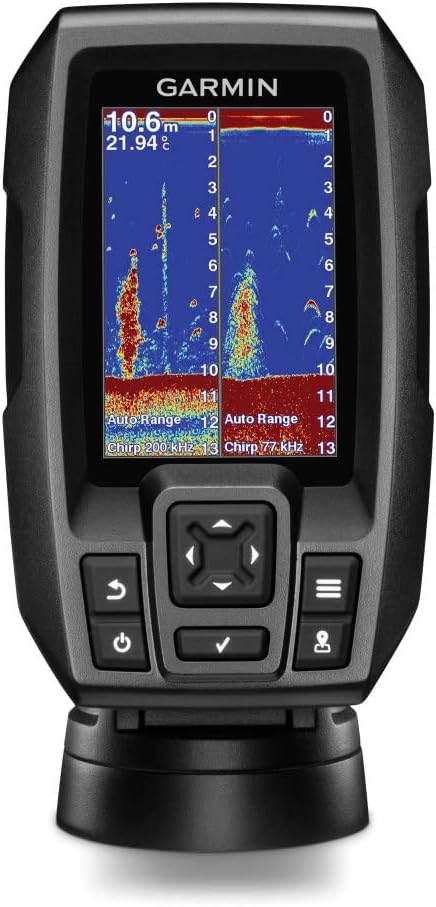
Garmin 010-01550-00 Striker 4
4.6Editor score
Clear Vu scanning Sonar images
Keyed interface with dedicated buttons
Waypoint map for navigation
Finding the right fish finder for a small boat can be challenging due to space constraints and budget limitations. You need a device that offers clear sonar images, reliable GPS, and easy installation without cluttering your deck or console. This guide reviews ten top models designed specifically for kayaks, pontoon boats, and small runabouts.
We evaluated each product based on sonar clarity, display quality, GPS functionality, and ease of use. Our comparison includes units with traditional sonar, CHIRP technology, and scanning sonar capabilities. We also considered portability, battery life, and durability to ensure these finders withstand the rigors of outdoor fishing environments.
Each pick highlights key features, pros, and cons to help you make an informed decision. Note that prices and availability change frequently, so check current listings before purchasing. Whether you are a beginner or a seasoned angler, this list covers options ranging from budget-friendly handhelds to advanced chartplotters.
4.6Editor score

4.7Editor score

4.4Editor score
As an Amazon Associate we earn from qualifying purchases.
This table provides a side-by-side comparison of all ten selected fish finders. Review the key specifications including display size, sonar type, GPS features, and unique capabilities to find the model that best fits your small boat setup.

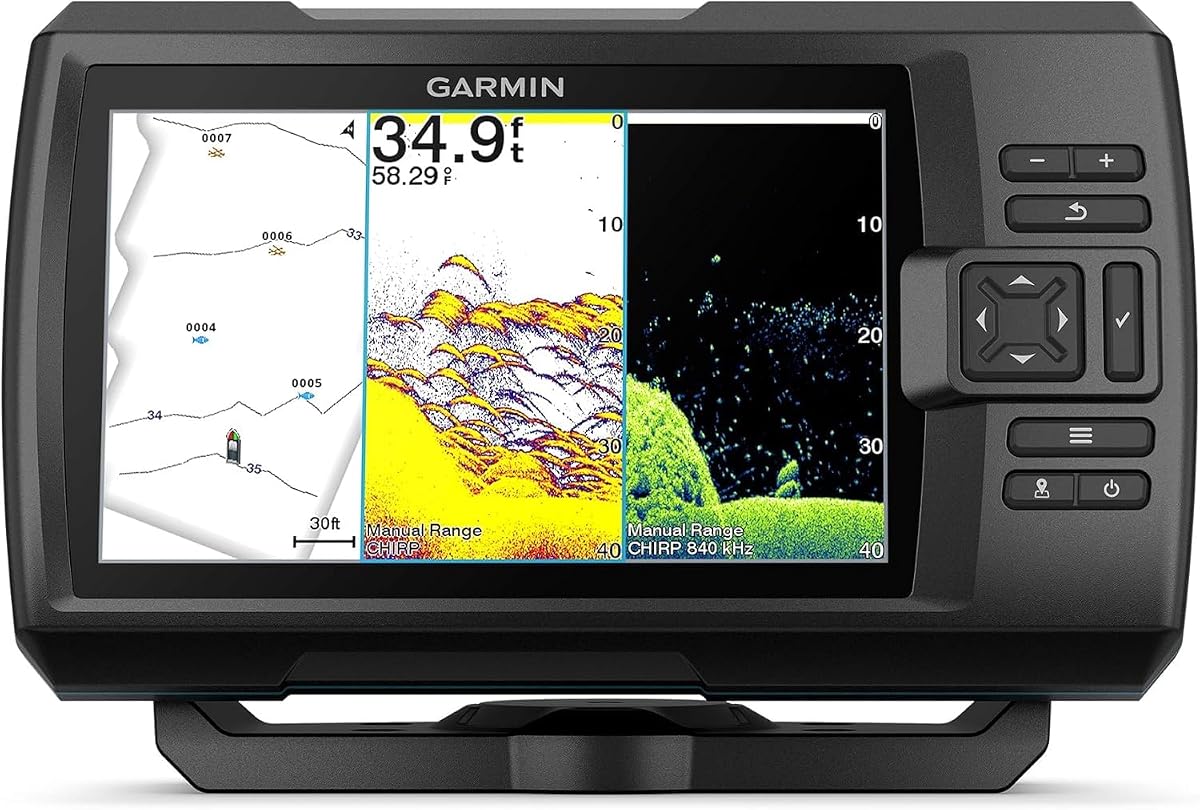


The Garmin STRIKER Vivid 4cv is a top-rated fish finder designed for ease of use and clarity. With a 4.7-star rating, it offers vivid scanning sonar color palettes that make distinguishing fish and structure straightforward. Its compact size makes it ideal for small boats where space is limited.
We may earn a commission when you buy through this link, at no additional cost to you.
This model includes a GT20 transducer that provides both CHIRP traditional sonar and CHIRP ClearVü scanning sonar. The high-sensitivity GPS allows you to mark waypoints, create routes, and view your boat speed. The Quickdraw Contours mapping feature helps you create detailed depth maps of your fishing areas.
While the 4-inch screen is smaller than some competitors, it remains bright and readable in sunlight. The lack of Wi-Fi limits remote data transfer but keeps the device simple. For anglers prioritizing straightforward operation and reliable sonar images, this unit delivers excellent value.
Buyers looking for a balance of performance and portability will appreciate this fish finder. It suits casual anglers and those new to electronics who want reliable data without complex menus. We recommend this model for small boats, kayaks, or pontoons needing essential GPS and sonar features.
Vivid scanning sonar color palettes provide clear differentiation between fish and underwater structure.
High-sensitivity GPS enables waypoint marking and route creation for efficient navigation.
We may earn a commission when you buy through this link, at no additional cost to you.
The Garmin Striker 4 offers a budget-friendly entry into fish finding technology with solid performance. Rated 4.6 stars, it features Clear Vu scanning Sonar for near-photographic images of objects and fish. The keyed interface ensures easy use without complex menus for beginners.
We may earn a commission when you buy through this link, at no additional cost to you.
This unit includes a waypoint map for navigating to brush piles or docks. It supports CHIRP Sonar for crisper fish arches and better target separation. The built-in flasher format is ideal for ice fishing or vertical jigging scenarios where traditional views are preferred.
The 3.5-inch display is compact but may feel small for extended viewing sessions. Water resistance is rated IPX7 for protection against immersion. While it lacks advanced mapping, it covers essential sonar and GPS needs for casual fishing trips on small vessels.
Anglers seeking an affordable and reliable fish finder should consider this model. It works well for beginners who need basic functionality without overspending. We suggest it for small boats or kayaks where a compact device is advantageous.
High-frequency sonar provides detailed representations of underwater objects and structure.
Waypoint map allows users to mark and navigate to specific fishing locations easily.
We may earn a commission when you buy through this link, at no additional cost to you.
The Humminbird Helix 5 Chirp GPS G3 combines advanced sonar with robust navigation features. Rated 4.4 stars, it delivers views of fish arches using Dual Spectrum CHIRP Sonar with Wide and Narrow modes. Enhanced GPS navigation includes coverage of 10,000+ lakes.
We may earn a commission when you buy through this link, at no additional cost to you.
Real-Time Mapping via AutoChart Live creates depth contour and vegetation maps while you boat. This feature allows you to record up to eight hours of data on SD cards. User-friendly menu systems allow reliable operation in any weather conditions with intuitive button interfaces.
Although the 4.4 rating reflects strong performance, some users may find the menu system complex. The premium price reflects advanced capabilities like mapping and CHIRP technology. For serious anglers needing detailed maps and precise sonar, this unit is a top choice.
This fish finder suits experienced boaters who need reliable chartplotting and high-resolution sonar. It is well-suited for small boats requiring advanced navigation without a full-size chartplotter. We recommend it for those willing to invest in premium features.
Dual Spectrum CHIRP Sonar offers two ways to search for detailed scanning or maximum coverage.
AutoChart Live creates maps of depth and vegetation while boating for better route planning.
We may earn a commission when you buy through this link, at no additional cost to you.
The Humminbird PiranhaMAX 4 is a straightforward fish finder offering dual beam sonar options. It allows you to choose between a narrow beam for detail or a wide beam for coverage. This versatility helps identify fish, structure, and contours effectively.
We may earn a commission when you buy through this link, at no additional cost to you.
The unit includes a tilt and swivel mount for quick adjustments to viewing angles. An XNT 9 28 T transom-mount transducer comes with the package. It supports a 1-Year Limited Warranty for added peace of mind during the first year of use.
While it lacks advanced GPS or mapping features, the core sonar performance is reliable. The interface is simple but may lack customization options for advanced users. For anglers focused purely on finding fish without navigation needs, this is a solid pick.
We recommend this model for budget-conscious users needing a durable sonar unit. It works well on small boats where GPS is handled separately or via phone. This unit is best for anglers who value simplicity and direct sonar views.
Choose from narrow and wide beams to balance detail and coverage area effectively.
Tilt and Swivel Mount allows fast adjustments to viewing area angle as needed.
We may earn a commission when you buy through this link, at no additional cost to you.
The Garmin Striker Vivid 7cv brings a larger 7-inch display for superior visibility. It uses Vivid scanning sonar color palettes to distinguish fish and structure clearly. Wi-Fi connectivity allows connection to the ActiveCaptain app for smart notifications and waypoint transfer.
We may earn a commission when you buy through this link, at no additional cost to you.
High-sensitivity GPS helps mark waypoints and view boat speed. The Quickdraw Contours mapping feature is built-in for detailed depth mapping. A GT20 transducer provides CHIRP traditional sonar and CHIRP ClearVü scanning sonar for comprehensive underwater views.
The larger screen may be too bulky for very small boats or kayaks. Power consumption is higher than smaller units, requiring a robust battery setup. For those needing better visibility and connectivity, this unit offers significant advantages.
We recommend this model for small to mid-sized boats where screen space is available. It suits anglers who want to use a smartphone for additional features via ActiveCaptain. This unit is ideal for those prioritizing display quality and connectivity.
The 7-inch color display provides excellent visibility even in bright sunlight conditions.
Wi-Fi connectivity enables smartphone integration for updates and data transfer.
We may earn a commission when you buy through this link, at no additional cost to you.
The Lowrance Eagle Fish Finder simplifies fishing with Auto-Tuning Sonar that optimizes settings automatically. Its 4-inch IPS portrait screen stays clear in bright sunlight and polarized sunglasses. This reduces adjusting time so you can focus on finding fish.
We may earn a commission when you buy through this link, at no additional cost to you.
The included 200 kHz Bullet Skimmer transducer delivers a broad 44-degree beam ideal for kayaks and small boats. Fish icons with depth and zoom features help identify target species clearly. The twist-lock connector makes connecting and removing the display simple and fast.
While it offers solid auto-tuning features, advanced customization is limited. It is designed for simple operation without extensive setup steps. For users prioritizing ease of use and clear display, this model serves well.
We recommend this fish finder for anglers wanting minimal setup and maximum focus on fishing. It is well-suited for small boats with limited deck space. This unit provides reliable performance for casual and intermediate fishing needs.
Auto-Tuning Sonar automatically provides optimized settings so you can focus on finding fish.
The IPS screen remains visible from wide angles even in harsh sunlight.
We may earn a commission when you buy through this link, at no additional cost to you.
The LUCKY Kayak Portable Fish Finder features wireless control and operation with a massive 853FT range. It reveals exact fish depth and location relative to structure. The handheld display and floating sensor are lighter than a 1-liter water bottle.
We may earn a commission when you buy through this link, at no additional cost to you.
You can tie the sensor to your fishing line and cast it like a bobber into promising water. The 3.5-inch LCD display shows clear fish icons and depth numbers. The screen scrolls history continuously so you track fish movement as you drift.
While wireless, it requires casting the sensor which may limit hands-free use. Battery life varies depending on usage but the unit is rechargeable. For kayak anglers avoiding permanent mounting, this unit is incredibly convenient.
We recommend this model for shore fishing, kayak fishing, and ice fishing. It suits anglers who want portability without drilling into their vessel. This unit is ideal for exploring waters where fixed sonars cannot reach.
Experience ultimate freedom with wireless control that eliminates wires and limits.
The lightweight sensor and display are pocket-sized and easy to transport.
We may earn a commission when you buy through this link, at no additional cost to you.
The Garmin Striker Plus 4 is built for rugged environments with a bright 4.3-inch display. It includes a dual-beam transducer for crystal-clear images and target separation. Built-in GPS lets you mark waypoints, create routes, and view boat speed.
We may earn a commission when you buy through this link, at no additional cost to you.
Quickdraw Contours mapping allows you to create and store maps with 1 contours for up to 2 million acres. Frequencies supported include traditional 50/77/83/200 kHz with 200 W transmit power. The intuitive user interface makes navigation straightforward.
Although the mapping limit is 2 million acres, it is sufficient for most regional anglers. The touch control may be tricky with wet hands or gloves. For durability and essential features, this unit holds up well.
We recommend this fish finder for anglers fishing in saltwater or rough conditions. It suits those needing a rugged unit with mapping capabilities. This model is best for users valuing reliability and sunlight readability.
Built to withstand every fishing environment with durable construction.
Quickdraw Contours software enables detailed depth mapping of your local waters.
We may earn a commission when you buy through this link, at no additional cost to you.
The Humminbird PiranhaMAX 4 DI offers Down Imaging for a clear view below your boat. You can view timber, brush, bridge pilings, and rocks with sharp detail. Dual Beam Sonar lets you choose beam widths for detail or coverage area.
We may earn a commission when you buy through this link, at no additional cost to you.
It includes a 4.3-inch color LCD with a redesigned, easy-to-use interface. Features include Fish ID+, fish alarms, depth alarms, and zoom for a closer look. An XNT 9 DI T transom-mount transducer is included for installation.
While Down Imaging is a major plus, this unit lacks built-in GPS. This makes it ideal for anglers focusing solely on sonar clarity. The display quality supports detailed viewing of underwater structure.
We recommend this model for anglers seeking detailed structure scans. It suits small boats where GPS is not a primary need. This unit is best for those prioritizing imaging clarity over navigation.
Down Imaging provides sharp detail of structures like timber and pilings below.
The redesigned interface is even easier to use for quick adjustments.
We may earn a commission when you buy through this link, at no additional cost to you.
The Garmin STRIKER 5CV offers a 5-inch display that balances size and performance. It includes a transducer for built-in CHIRP traditional sonar and CHIRP ClearVu scanning sonar. Built-in GPS helps mark waypoints and view boat speed effectively.
We may earn a commission when you buy through this link, at no additional cost to you.
Quickdraw Contours mapping software lets you store maps with 1 contours for up to 2 million acres. The unit is designed to be sunlight-readable with an intuitive user interface. The rugged design ensures durability for every fishing environment.
Compared to the Vivid series, color palettes are more basic but functional. For the price, it provides strong value for essential sonar and mapping features. It suits anglers needing a reliable mid-size unit without premium extras.
We recommend this model for budget-conscious anglers wanting a 5-inch screen. It is well-suited for small boats needing essential GPS and sonar. This unit is best for those prioritizing durability and practical mapping tools.
Includes both CHIRP traditional and ClearVu scanning sonar for comprehensive coverage.
Quickdraw contours mapping software allows creation of detailed depth maps.
We may earn a commission when you buy through this link, at no additional cost to you.
Choosing the right fish finder for a small boat requires balancing size, features, and budget. This guide outlines key factors to help you select a unit that fits your vessel and fishing needs.
The display size affects how easily you can read sonar data while boating. For small boats, a 3.5 to 5-inch screen is ideal to conserve space. Ensure the screen is sunlight-readable so you can see details without glare.
Look for IPS or bright displays that work in direct sunlight. A clear view of the screen is essential for interpreting fish arches and structure accurately.
Sonar technology varies from traditional sonar to CHIRP and scanning sonar. Traditional sonar provides basic depth and fish detection. CHIRP sonar offers better target separation and clearer arches. Scanning sonar gives detailed images of underwater objects.
Choose CHIRP or scanning sonar for better accuracy in complex waters. Basic sonar may suffice for simple shallow-water fishing where detail is less critical.
Built-in GPS allows you to mark waypoints and navigate to fishing spots. Mapping software can store contours for depth and structure. This feature is vital if you fish multiple locations or need to track routes.
Ensure the unit supports waypoints and routes. Built-in Quickdraw or similar mapping simplifies planning without needing external software.
The transducer sends and receives sonar signals. Most units include a transom-mount transducer. Wireless or castable transducers offer flexibility for kayaks or small vessels without fixed mounts.
Check if the transducer is included. Consider if you need a dual-beam or single-beam transducer based on your coverage needs.
Small boats often have limited space, so mounting options matter. Tilt and swivel mounts allow adjusting viewing angles. Some units are portable and battery-powered for shore or kayak use.
Select a unit with a mounting bracket included. If drilling is not an option, consider wireless or portable units with suction cups.
Fish finders draw power from your boat's battery. Units with lower current draw help preserve battery life. Check the current draw at 12 volts before purchase.
Ensure your boat has sufficient power capacity. Smaller units typically consume less power, making them better for small batteries.
Prices range from under $150 to over $400 depending on features. Budget units offer basic sonar and GPS. Advanced models provide mapping, Wi-Fi, and high-resolution displays.
Balance your budget with necessary features. Investing more may bring better imaging and navigation tools for long-term value.
Fishing environments can be harsh with rain and splashes. Look for water ratings like IPX7 to ensure resistance against immersion. Rugged construction protects against accidental drops.
Choose a durable unit with strong protection. This ensures reliability over time even in tough weather conditions.
Install the transducer according to the manual ensuring it faces the water directly. Proper mounting ensures clear signals and avoids errors. Place the unit securely so it does not vibrate excessively while boating.
Calibrate settings like sensitivity and range before heading to the water. Adjust these to suit depth conditions. Regular calibration ensures accurate readings during your fishing trip.
Clean the display and transducer after each use with fresh water. Store the unit in a dry place to avoid damage. Periodically check connections and cables for wear to maintain performance.
A 3.5 to 5-inch fish finder is usually best for small boats due to limited space. It provides enough screen real estate to read sonar data clearly while leaving room for other gear. Units like the Garmin Striker 4 or Lowrance Eagle offer compact dimensions.
A GPS fish finder helps mark waypoints and navigate to fishing spots efficiently. If you fish multiple locations or need to track routes, GPS is valuable. However, basic sonar units work if you rely on landmarks for navigation.
CHIRP sonar sends a sweep of frequencies to produce clearer images with better target separation. It helps distinguish fish from structure more accurately than traditional sonar. This technology is common in modern fish finders for improved clarity.
Most units come with a transom-mount bracket that attaches to the rear of the boat. Ensure the transducer is submerged and aligned properly. Some units offer tilt and swivel mounts for better viewing angles.
Portable fish finders are effective for kayaks or boats without mounting points. They use wireless sensors that can be cast into the water. While they offer flexibility, fixed units generally provide more consistent data.
Battery life depends on the unit and usage conditions. Most units can run for 8 to 12 hours on a single charge. Portable models may have shorter lives, so bring a backup if needed.
Yes, many fish finders are rated for saltwater use. Look for models with corrosion-resistant parts or specific saltwater transducers. IPX7 water resistance ensures durability against splashes and spray.
Sonar displays depth and fish below the boat. Scanning sonar provides detailed side or forward views of underwater structures. Scanning gives more context about the environment around your boat.
The ten models reviewed provide a range of options for every angler and budget. The Garmin Striker 4 and Lowrance Eagle offer affordability with essential features. The Humminbird Helix 5 provides premium navigation and mapping for advanced users.
Prioritize sonar clarity and ease of use when selecting your device. Features like CHIRP and GPS can greatly improve your fishing experience. Choose a size that fits your vessel comfortably for optimal performance.
Remember that prices and availability change frequently so check current listings before purchasing. Investing in the right fish finder will enhance your time on the water significantly. Consider your specific needs before committing to a model.